Wednesday, May 31, 2006

Transportation Tax Breakdown

Major props to Mike Lindblom of the Seattle Times for this detailed report that gets to the bottom of just how much money we are currently forking over in transportation taxes —and how much more we could be forking over very soon.

As Seattle Mayor Greg Nickels asks voters to spend more money on city roads, and King County Executive Ron Sims promotes a countywide sales-tax boost for more buses, the annual local tax bill for transportation already exceeds $800 per adult.

The dollars are collected in so many ways — state and federal gas taxes, sales taxes, car-tab taxes, property taxes, business taxes, real-estate tax — that the average person doesn't know the bottom line.

A Seattle Times review of major transportation taxes estimates that agencies collected an average of $843 per adult in urban areas of King County, including Seattle, last year. The figure for Seattle residents is $881. Roughly half the money went to transit, and half to roads.

In addition to this year's proposals by Nickels and Sims, another pair of multibillion-dollar packages — for Sound Transit and regional highways — appear headed toward the ballot next year.

If all four measures win, the area's transportation investment likely would exceed $1,000 per adult in both Seattle and its suburbs.
I have been noticing this nagging feeling lately that maybe I'm not quite paying enough in taxes. Wait... no. And what's the deal with the money being split half and half between roads and public transit? Last I checked, far fewer than 50% of trips in our area are on public transit. Is 50% even a remotely reasonable goal? (I really would like to know—does anyone know where I can find studies of highly "transit friendly" cities?) Why is so much money being dumped into a "solution" that accommodates so few people, even while the roads are being "overwhelmed by growth in the motoring population"?

Oh, and I especially love this bit:
To avert a "roads-vs.-transit" fight, state lawmakers have required the highway and Sound Transit measures to pass together, or they both fail.
I just have to ask... why?

(Mike Lindblom, Seattle Times, 05.27.2006)

Tuesday, May 30, 2006

Freeway Neighbors Worried About Noise

There are plans in the works to make significant improvements to I-405, including some major widening action. Of course, while freeway improvements are good, it's pretty much impossible for any kind of progress to happen anymore without some group protesting the change. For this project, it is nearby homeowners concerned about noise .

Residents who live along Interstate 405 already know how loud traffic noise can be as they barbecue on their decks and patios.

Now, some homeowners in south Bellevue neighborhoods are worried about how much worse it could get once planned widening projects move the freeway even closer to their backyards.

In addition to noise walls, the traditional way to dampen the freeway din, they want state Department of Transportation officials to consider a less-tested way to mitigate noise: rubberized asphalt.
...
Officials say surveys of noise at dozens of sites on I-405, and computer modeling that predicts future levels, show most locations will not experience levels that push them above the state's limit of 66 decibels.

If the noise is louder than that, mitigation measures such as noise walls must be considered. At 67 decibels, two people having a conversation, standing five feet apart, would have to raise their voices to hear each other.

Though residents have expressed concerns about other issues, such as drainage, environmental impacts and freeway alignment, the potential for increased freeway noise tops the list, said Goran Sparrman, director of Bellevue's transportation department.
...
In the case of the rubberized asphalt on 104th Street [in Bellevue], it began to deteriorate after just a few years.

"Our experience is that it works well for a couple of years," Sparrman said.

"But the problem for us is it doesn't wear like normal and it comes out in chunks."
I can understand not wanting more noise, but I don't really see what the big deal is here. The state has clear rules about noise levels and mitigation methods, and those rules are being followed already. Did these people buy their homes next to the freeway expecting the noise level to decrease? Why are they trying to push an inferior and expensive solution to a non-existent problem?

(David A. Grant, King County Journal, 05.30.2006)

Friday, May 26, 2006

Traffic Court

Following is a lengthy post about my experience in traffic court yesterday. Some of you may find it boring, so I didn't want to flood the entire main page with it. Short story: "Deferred finding." Long story...

View/Hide the expanded post.


Due to the bus schedule I arrived roughly 20 minutes early for my 10:00 court appointment. This gave me the opportunity to witness a few cases. I was in the King County District Court, room E-341, with Judge Mark Chow residing. Apparently everyone whose ticket involved a collision is sent to this court.

In the first case I was present for, a lady who was in the middle of a three-car rear end collision on I-5 was contesting a ticket for "following too closely." She rambled on for a long time, basically saying nothing more than "I think I only felt one impact" and more or less claiming that she was pushed into the car in front of her by the SUV that hit her and then fled the scene. She presented a—shall we say—less than compelling case, and yet the judge dismissed her ticket.

The next case was a lady that rear ended someone on I-405 in stop-and-go traffic and was ticketed for "speed too fast for conditions." The best she could come up with was "I didn't have time to stop," and when pressed on why she didn't have time, she said "I might have been distracted." Her citation was not dismissed, however she was offered a reduced fine or a deferred finding (more on those later).

Next up was a gentleman that was ticketed for failing to provide proof of insurance. He admitted to not having insurance, so the judge asked if he had been ticketed for no insurance before. He said that he had not. Then the judge pulled up his record and found out that—what do you know—he had; in '02 and '04. He was ordered to pay the full fine of $538. Ouch. This was the only case where the infraction was not dismissed or the defendant offered a reduced fine or deferral.

The 10:00 session didn't actually start until 10:25, at which point the judge called roll. Two of the individuals in the group were non-English speaking, and had interpreters. They both got to go first, simply because they had the interpreters. The first one was ticketed for "improper lane usage" and had hit the side of another vehicle. For some reason, he decided to subpoena as a witness the driver of the other vehicle. On the stand, this driver explained that they were at a full stop when suddenly the defendant's truck was implanted in the driver's side of their vehicle. The defendant brought photographs that for some reason didn't even show the scene of the collision, and tried to claim that the other driver somehow hit him. The judge didn't buy it, but because of his good record gave him the reduced or deferred option.

The next guy barely said anything. He basically just told the judge that two cars collided ahead of him and he couldn't avoid hitting them. The judge agreed, and dismissed the charge.

The last to go before me was a lady that brought a lawyer along, and to be honest the lawyer was talking so much legalese I'm not really sure what the charge was or what was going on at all, but whatever it was, it was dismissed.

Finally at about 11:00, it was my turn to go. The basic outline of my case was that the state is required to "prove by a preponderance of the evidence" that I committed the infraction of driving "at a speed greater than is reasonable and prudent under the conditions." Given that the state troopers arrived on the scene after the fact, and given that there are multiple plausible ways to lose control of a vehicle despite traveling at a safe speed (oil slick in the road, tire blowout, evasive maneuvers after being cut off, violent sneeze, etc.), the state can offer no such evidence (because I wasn't driving "too fast for conditions"). Therefore the infraction must be dismissed.

I attempted to give the judge a copy that I had prepared of the outline of my argument, but he refused to accept it, stating that it was "too long." I made my case, and he basically said that the fact that my car was wrecked was circumstantial evidence and was proof enough. Apparently Judge Chow could not possibly fathom that there are other ways to lose control of a vehicle. End of story.

The two options that were offered to me and others were: 1) Pay a reduced fine of $40, and the ticket goes on your driving record. 2) "Deferred finding," which basically amounts to a state-sanctioned bribe. If you pay a flat $100 fee and don't get any tickets for the next 12 months, they let you off. It's a codified version of Mexico's "slip the officer a few $20s and be on your way." Since I value having a clean driving record, I selected the bribe option.

Obviously I'm frustrated that the judge was unwilling to reason with me, but there are a couple of things that particularly bug me about the whole ordeal. It's not really the money that bothers me. Sure, it sucks to flush another hundred bucks after I already tossed $500 (the value of the wrecked car) and $150 (the towing fee), but to be honest $100 isn't all that much money to me anymore. What really bugs me is that Judge Mark Chow is basically calling me a liar. The fact that I was intimately familiar with the handling capabilities of my vehicle of nine years, and I knew for a fact that I was not traveling at a speed greater than was "reasonable and prudent under the conditions" didn't matter one iota. That is an unacceptable assault on my honor, and I really didn't appreciate it.

Furthermore, I realized something yesterday afternoon as I pondered my experience and the other cases that I witnessed. I realized that every one of them followed a simple pattern:
  • Judge Chow reads the defendant the accident report.
  • He listens to the defendant's explanation.
  • He asks a few questions, converses with the defendant for a short time.
  • He makes his ruling based entirely and solely on the accident report.
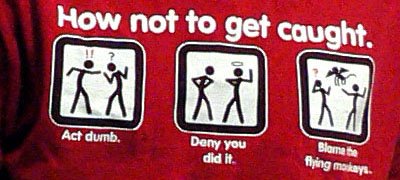
Before this pattern dawned on me I was really confused how a few of the people ahead of me were able to have their ticket dismissed when they offered weak or virtually no explanation for their actions. Once I realized the judge's method of operation though, it frustrated me even more. Why bother wasting time with the whole charade at all if the judge isn't really considering what you have to say? I could have worn my "blame the flying monkeys" t-shirt, and even used the "blame the flying monkeys" strategy, and the outcome would have been no different. It's not that I really had all that much faith in the justice system to begin with, but I guess now it's approaching zero.
blame the flying monkeys
Sure, I could prepare a more rock-solid and convincing case and defend my honor with an appeal, but what's the point when there's really no reason to believe that another judge will listen to me either? So rather than spend another $240 on an appeal, I'm venting my frustrations here. Although the official government "public records" may show that I committed this infraction, this public record contains the truth of my innocence.

All in all it was a very disappointing experience. Fate knocked me to the ground and the so-called "justice" system kicked me in the gut while I was down. At least nobody/nothing was hurt except my crappy car and my honor.
Hide the expanded post.

Thursday, May 25, 2006

My Thrilling Schedule Today

Back in March I lost control of my car on the 520 onramp to southbound I-5. It smashed into the right wall, then the left wall before coming to a stop. Thankfully, no one else was involved, and my car had enough left in it to move to the side of the road out of traffic. Roughly ten minutes later some Washington State Patrol officers showed up on the scene to write up an accident report. Oh yeah, and to write me a ticket for "speed too fast for conditions."

I've got a 10:00 court appointment downtown today. The way I see it, the state doesn't have a leg to stand on, since the ticketing officer wasn't even there to witness my speed (which was not too fast, by the way). I'll report back here tonight on how it goes.

Tuesday, May 23, 2006

Homeowners To Fund Road Repairs?

What's the solution to Seattle's traffic problems? Well, apparently if you ask the Mayor, the solution is a tax hike... on homeowners.

Since 1998, voters have passed five levies: $117 million for education, $86 million for low-income housing, $72 million for the Seattle Center and community centers, $198 million for parks and $167 million for fire-fighting facilities.

The result is a four-fold increase over the past 10 years in what the average homeowner pays for levies. The owner of the average home in Seattle 10 years ago paid $104 for voter-approved levies. This year, the owner of the average home — assessed at $399,200 — will owe $459.

Today, Mayor Greg Nickels is expected to propose a new levy and other taxes — not for shiny new buildings, but to repair roads and bridges. His citizen advisory committee has suggested a levy of $25 million a year, and Nickels may choose to go higher.

"The need is clear, not only for the routine work of paving streets but also for the bigger projects, such as our aging bridges," Nickels said in his State of the City speech in March when he announced that he would explore a new way to fund repairs.
...
The new road-repair levy would signal a departure from how Seattle has used levies in the past. Previous levies were sold to the voters like Procter & Gamble products — offering something new and improved, such as new parks, fire stations and community centers.

This levy would improve roads but not pay for any new ones. The money would fill potholes, repaint crosswalks, repave roads — in other words, pay for tasks voters have come to expect government to include in its general budget.
Granted, Seattle homeowners seem only too happy to spend far more money than necessary for overpriced real estate and granite countertops—and a few hundred dollars per year isn't going to break anyone's bank. But what is the deal with begging for more money just to do (supposedly) routine maintence? What in the heck are they doing with the general budget?
Nickels said the city needs new money for road repairs to make up for funding that used to come from the state.
I don't quite buy that argument, and as it turns out, neither does the state legislature.
State Senate Transportation Chairwoman Mary Margaret Haugen, D-Camano Island, said she was "aghast" at Nickels' complaints about state funding. In the $8.5 billion gas-tax package the state passed in 2005, Seattle received $2.8 billion for projects like the viaduct and the 520 bridge, and an additional $2 million a year for maintenance, she said.

"The largest share certainly went to Seattle," Haugen said. "That was one of the things that people had heartburn about in the rest of the state."
So, we're getting billions of State dollars for all kinds of fancy projects, but we have to jack up the tax on (already stretched) homeowners to afford to fix potholes? Something just doesn't add up. I could be way off base here, but I can't help picturing Mayor Nickels sitting at his desk with dollar signs in his eyes, thinking about the soaring property "values" in Seattle and wondering just how much more in taxes the populous will tolerate.

This was cross-posted at both Seattle Bubble and Seattle Traffic.

(Sharon Pian Chan, Seattle Times, 05.22.2006 )

Monday, May 22, 2006

Commuters Unfazed By Gas Prices

Using weeks-old news about America's longest commutes as a pretense, Danny Westneat actually makes an insightful point about our attitudes toward gasoline .

These commuters may sound extreme. But it's only a matter of degree. The truth is rising gas prices haven't led to any drop-off in driving, by you, me or almost anyone. The feds just reported America is using more gas this year than last.

Why? Because except for the poorest among us, gas isn't that expensive. Regardless of pandering politicians saying it is.

Some say nothing will change until gas hits $4 a gallon, and stays there. Or $6.

I don't know. I do know if a stylist is happily driving 820 miles a week to cut hair, our gas crisis isn't registering as one.
I would have to agree. Although people may whine and complain about gas prices, they show by their (lack of) actions that it really isn't all that big of a deal to them. Personally, I've been fed up with gasoline since before prices even started with a 2. $3 per gallon gas hasn't changed my opinion—I still hate gasoline, and am doing my best to work toward eliminating it from my lifestyle.

Actually it's not entirely true that people's actions have not been affected by this. They're buying locking gas caps, remember? Don't we all just feel so much better now?

(Danny Westneat, Seattle Times, 05.14.2006)

Thursday, May 18, 2006

Seattle Drivers (Not Really) Courteous

It's almost as if there's some kind of unwritten rule that at least once a year someone has to write a story about how "polite" Seattle drivers are on the road.

In a survey by AutoVantage released this week, Seattle drivers were rated as among the most courteous — less likely to change lanes without signaling or swear at fellow motorists. But many in this region say it's a reputation that's dead-on, but not always welcomed.

"There are many drivers who think that yielding right of way is always a courtesy, when in actuality it can be frustrating or even dangerous," said Dan Manville, 27, a library technician from Tacoma.

Stopping to let pedestrians cross when there is no marked crosswalk is one example, he said. Another is the "famous reluctance" to go first at a four-way stop.
Those things aren't polite or courteous... they're just stupid. Traffic laws are designed to make traffic flow smoothly. When someone stops unnecessarily to let a pedestrian jaywalk or breaks the pattern at a four-way stop, that screws up traffic. Speaking of traffic laws, there's one part of the article that I have to take exception to:
"Yes, they're polite, but they're also very passive-aggressive," said Robert Heath, 40, an e-commerce consultant who moved here from Los Angeles six years ago. Seattleites, he said, don't have a clue how to drive in an urban area.

Nothing makes him crazier than this classic move: Drivers in the freeway fast lane who refuse to go fast, letting traffic pile up behind them.

"The culture is kind of this childish, 'I'm going to stick by the book,'" he said.

That's the worst form of passive-aggressive motoring, said Leon James, a psychology professor at the University of Hawaii who studies driving.

"The person is breaking all the rules and creating a traffic danger point, forcing others to go into the right lane to pass them," James said. "That one driver will upset hundreds of drivers in one minute. That's dangerous and selfish."
So, according to Robert, following the law is "childish," and according to Prof. James, following the law is equivalent to "breaking all the rules." Hmm. How exactly does traveling at the posted speed limit "force" anyone to go around on the right, pray tell? Could someone explain the "logic" behind that?

Consider this scenario: Driver A is driving down I-5 south of Olympia (where it's just two lanes in each direction). The right lane has a steady flow of semi trucks, RVs, and other slow-moving (as in, below the 70mph speed limit) vehicles. So Driver A sets his cruise control to 70 and keeps left as he glides past the slower traffic. Driver B is flying down the road at 85mph, and soon finds himself behind Driver A. Angrily reducing his speed to the unbearable crawl of 70mph, he waits for his opportunity, and when a slight gap appears between semis, he zips into the right lane (without signaling), speeds past Driver A, then cuts back into the left lane (again, no signal) and speeds back up to 85mph.

Can you sit there with a straight face and tell me that Driver A was the one that was creating a dangerous situation here? Don't even bother trying the old "the law requires you to keep right except to pass" argument. Is the driver traveling at 85mph keeping right? Furthermore, why is it okay for Driver B to exceed the speed limit by 15mph (breaking the law), but it is not okay for Driver A to stay in the left lane?

If the speed limits are set too low, we should petition the government to raise them. It doesn't make any sense to rage against people that choose to follow the law. And that's my rant for the day.

(Phuong Cat Le, Seattle P-I , 05.18.2006)

Wednesday, May 17, 2006

Viaduct Retrofit: The Undead Option

Just when we thought the retrofit option was dead in the water, here comes yet another study.

For months the state Department of Transportation has dismissed proposals to repair, not replace, the Alaskan Way Viaduct.

But now, the state plans to hire an engineering firm to study a retrofit plan crafted by retired structural engineer Victor Gray of Port Townsend.
...
"We don't think it's a good idea," said Ron Paananen, viaduct project manager.

"But they've gotten some attention from their latest proposal, and it seems reasonable to give it a look and see if it works technically."

The state has hired T.Y. Lin International to study the retrofit idea, the same company the state hired in 2001 to look at viaduct options. The company found a retrofit wasn't wise or cost-effective. Paananen, who expects the report to be completed in about six weeks, acknowledged the decision to study a retrofit option is a victory for Gray.

"We recognize there's a lot of people out there who still believe it can be retrofitted," Paananen said. "Let's see what the experts tell us."
Allow me to translate for Mr. Paananen. Basically what he's trying to say is:
There is no way in hell that we are just going to retrofit this thing. The directive has come down from the top, it's tunnel or bust. Unfortunately, the retrofit concept has received a lot of attention and public support lately. They're talking about saving money or something—whatever. So here's what we're going to do. We'll hire the same engineering firm that has already previously concluded that a retrofit would not work. They'll "study" Mr. Gray's idea, and report their findings. I strongly suspect that they will conclude that Mr. Gray's retrofit is not, in fact, a tunnel. Therefore, this silly retrofit concept will be dismissed once and for all.
I think that about sums it up.

(Susan Gilmore, Seattle Times, 05.17.2006)

Tuesday, May 16, 2006

Hot Air To Control Climate

According to a Ron Sims press release, King County is going to combat global climate change by... by... well it's not quite clear what they're going to do, aside from spew a bunch of hot air on the topic .

King County will be the first county and the first major bus transit agency in the United States to join the Chicago Climate Exchange, under a proposal by King County Executive Ron Sims.
...
"By joining the Chicago Carbon Exchange we expect to play a key role in determining how markets should operate, especially in the areas of transit and solid waste," Sims said. "We have to be innovative and forward-thinking if we are to prepare for and reduce the impacts of global warming on our future."
...
"King County has demonstrated strong leadership in our commitment to clean air and sustainable living – from our world-class bus system to well-run wastewater and solid waste systems, and ambitious forest preservation practices," said Councilmember Phillips. "By stepping forward now to become the first county in the United States to make a binding commitment to reduce greenhouse gas emissions, King County once again has a chance to lead the way for climate control solutions."

Sims believes that such regional efforts will ultimately influence the federal government to create a binding federal market, similar to that in Europe.
Leading by example, huh? That's a pretty good idea, one that many of our local officials are really good at... or not. I wonder, how often do you ride a bicycle to work, Ron?

(Press release, Ron Sims, 05.15.2006)

Monday, May 15, 2006

Free Parking Dying Downtown

Uh-oh. It looks like downtown businesses are taking a cue from the city and carving up the cash cow that is parking.

REI today starts charging for parking beyond one hour at its Seattle flagship store, proving once again that as a city grows, fewer things in life are free.

REI's 366-space underground lot had been unregulated ever since the store at 222 Yale Ave. N. opened 10 years ago. For most of those years, the outdoor-gear co-op was pretty much the neighborhood's only bait to draw shoppers. But as South Lake Union's skyline rapidly changed, bringing in more and more workers, visitors and residents, REI has had to rethink its charitable ways.

The new policy targets those in the neighborhood who have abused that generosity, stashing their cars in the lot for free, hour after hour, day after day. The REI lot proved a cheap substitute to parking at a pay lot and a convenient alternative to scouting for free parking along the street, where spaces increasingly are at a premium.

"Our garage is often full even on days of average business," Bobby Mullins, the store's business-operations manager, informed inquiring customers via letter. "We had to choose either free parking for everyone in the neighborhood or parking controls.
Actually I totally understand the need that they have to crack down. Unlike the city of Seattle, REI is a private business. Their parking spots are not a public resource, and they have every right to enforce a "customers only" policy. A "customers only" policy makes sense. A "cars get the heck out of our city" policy, not so much.

(Stuart Eskenazi, Seattle Times , 05.15.2006)